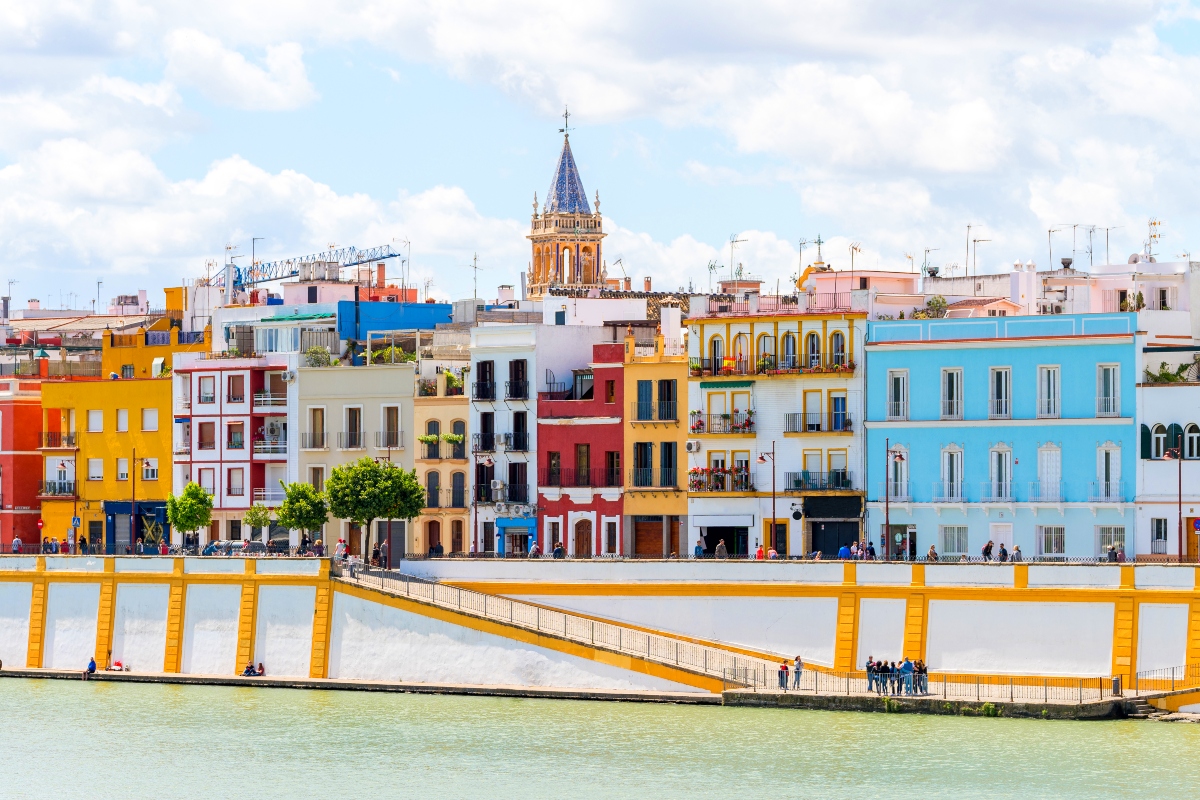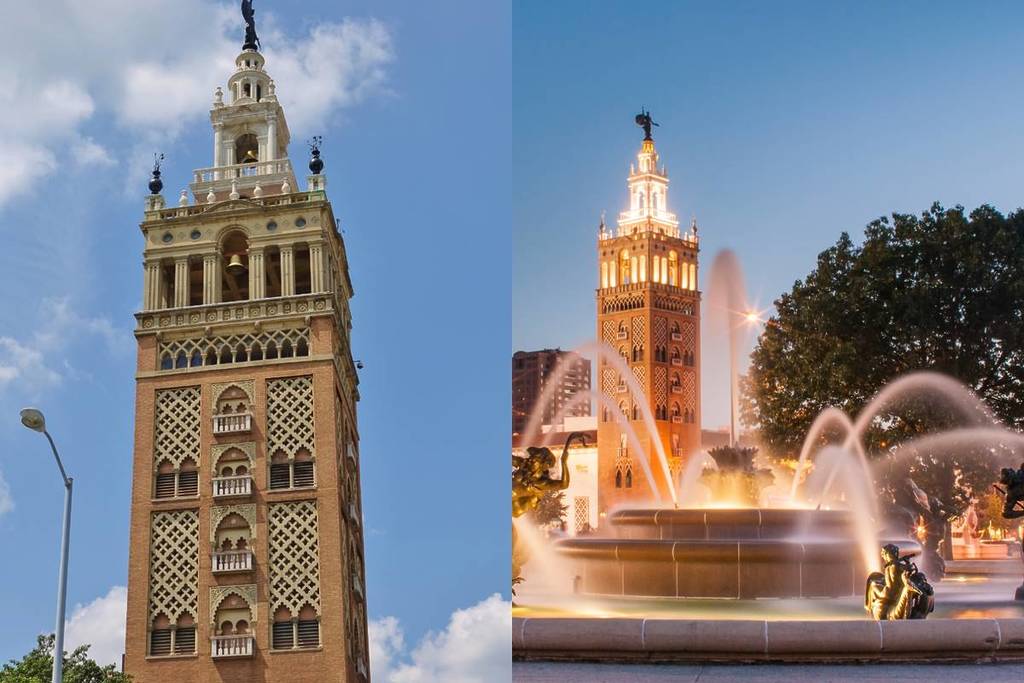

Of Seville’s architectural marvels, the Giralda is perhaps the most famous. A display of beauty that blends Almohad and Renaissance styles, crowned by the bronze weather vane that gives it its name. It’s no surprise that it has served as inspiration—and even a model—for other buildings. As a result, the Giralda has replicas all over the world, and one of the most surreal can be found in a shopping mall in Kansas City, in the United States.
What few people imagine as they stroll past store windows across the pond is coming face-to-face with the most iconic silhouette of Seville’s skyline, nearly 8,000 kilometers from Avenida de la Constitución.
Seville and Kansas City have been sister cities for more than half a century. This relationship flourished during the 1950s and 1960s, which explains the existence of this landmark on the other side of the Atlantic.
The fact is that this historic Sevillian gem—incidentally, its original color is not the one it sports today—continues to spark such interest that quite a few people have reimagined it.
Although Kansas City is not the capital of Missouri, it is the state’s most populous city and one of the few destinations in the world to feature a unique replica of the Giralda among its attractions.
The Koutoubia is a different story altogether—almost a sister to the Giralda and built a few decades earlier. In this case, both architectural marvels are similar because they draw on the knowledge, techniques, and principles of the Almohads.
A Giralda in the World’s First Shopping Mall
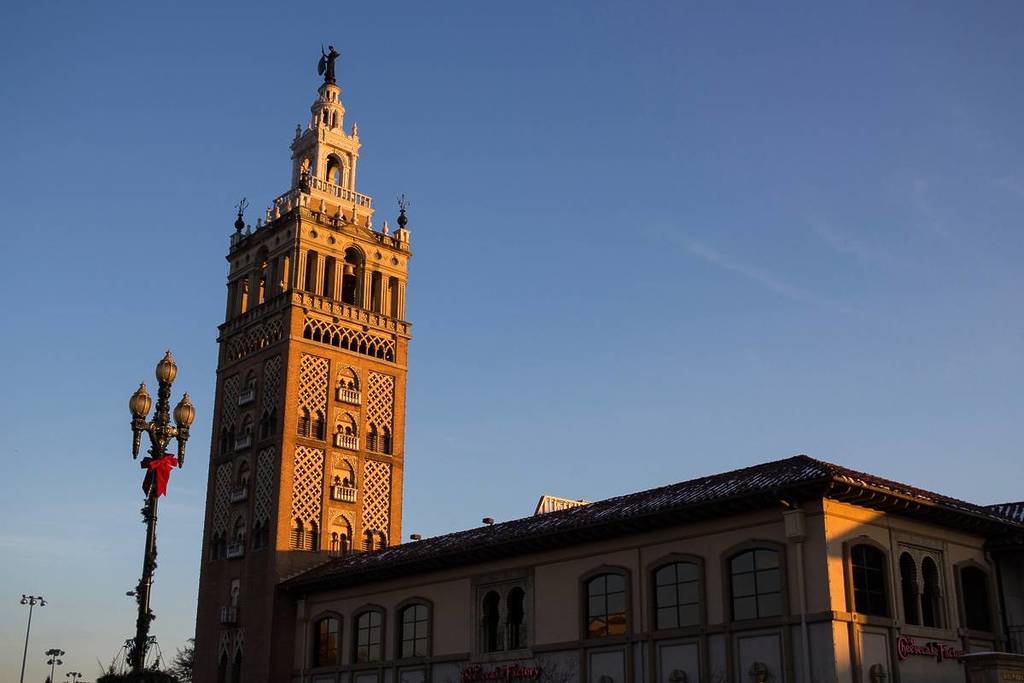
Far from the historical significance shared by both minarets, the Giralda in Kansas City was built purely on a whim and is part of the Country Club Plaza, considered the world’s first shopping mall.
The developer of this space, J. C. Nichols, entrusted the architectural design to Edward Buehler Delk, who traveled through Spain and South America in search of ideas for building this complex. The result, clearly inspired by Spanish architecture, is crowned by this reproduction of the Giralda, which his son completed in 1967.
It is not, however, the only nod to Seville that this American city reveals. It also reconstructed the Plaza Virgen de los Reyes and its fountain—designed by Bernhard Zuckerman—in the style of the one that stands at the foot of Seville’s Cathedral.
In return, Seville also made its close relationship with the city clear by naming one of its major thoroughfares after it.
In addition, the avenue in Kansas City itself features the equestrian monument *El Explorador* (The Explorer), a work by sculptor Cyrus Edwin Dallin, depicting a Native American on horseback. It was a gift from the city to Seville in connection with the 1992 World’s Fair.