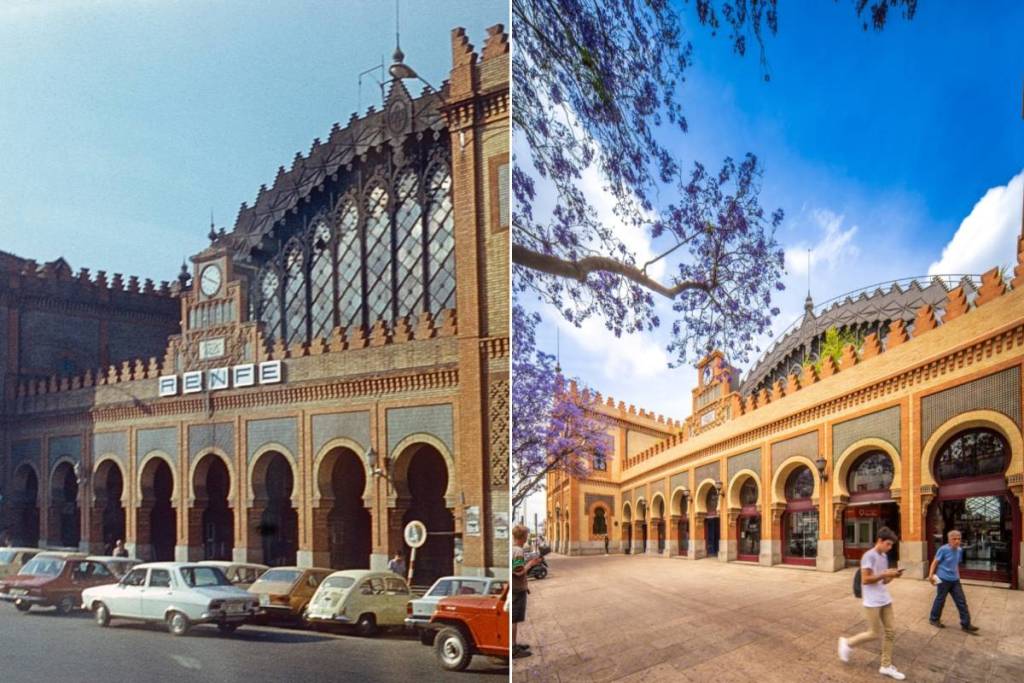

The train station built in Paris for the 1900 World’s Fair now houses the Musée d’Orsay and works by Renoir, Manet, and Degas, where the smell of coal once filled the air. The same logic applies to other old stations, such as the historic Córdoba Station in Seville, whose architectural hall now houses a shopping center with indoor terraces and movie theaters.
For nearly a century, however, it served as the main gateway to Madrid, Huelva, Extremadura, and the northern part of the peninsula. It was, in fact, the very spot where Inés Rosales would begin selling her world-famous olive oil cakes.
The Neo-Mudéjar gem by Santos Silva
In the late 19th century, the Madrid–Zaragoza–Alicante Railway Company (MZA) needed a first-class terminal to consolidate its connection with the Andalusian capital.
The project was entrusted to engineer José Santos Silva, who designed a landmark building that combined the technical prowess of the Industrial Revolution with Andalusian visual identity.
Built in the Neo-Mudejar and historicist styles, with echoes of the Great Mosque of Tangier and the Court of the Lions at the Alhambra in Granada, it was inaugurated in 1901.
Its façade combines exposed brick with an imposing central section, Neo-Mudejar elements, and, inside, a metal superstructure and a large iron-and-glass vault.
Although its official name was Plaza de Armas Station, the most direct and frequent destination of its lines earned it the nickname “Córdoba Station” in Sevillian memory for all time.
1990: The Final Whistle and the Catalyst of Expo ’92
For decades, the station witnessed farewells, the arrivals of illustrious figures, the commercial bustle of Andalusia, and a Seville that was gradually transforming. So much so that Seville’s designation as the host city for the 1992 World’s Fair accelerated a comprehensive urban redevelopment.
The arrival of high-speed rail (AVE) required modern infrastructure, which led to the construction of the Santa Justa station.
Likewise, the closure of the railroad line that ran along the river made it possible to dismantle the railway barrier and definitively open the city to the historic course of the Guadalquivir. In the fall of 1990, Córdoba Station bid farewell to its last commercial train after nearly ninety years of uninterrupted service.
During the six months of Expo ’92, the building served briefly as the Seville Pavilion, before its long-term role as part of the city’s civic heritage was decided.
From steam-era platforms to shopping arcades
Instead of condemning the building to abandonment or demolition—a common fate for many 20th-century industrial terminals—the decision was made to undertake an adaptive reuse project.
To that end, the former track and platform area was transformed into a multi-level shopping plaza where stores line the sides beneath the imposing original metal framework.
The complex now features a movie theater and dining areas. Its proximity to the intercity bus station provides the venue with a steady flow of local residents and travelers.
Our times, as well as our consumption habits, have transformed this space into a cultural hub capable of screening sports games on a big screen, hosting the Andalusian Alternative Comedy Festival (FACA), or events related to the Seville European Film Festival.
The renovation preserved the metal trusses, the rivets, and the skylight, keeping the structure’s industrial and railway past clearly visible.