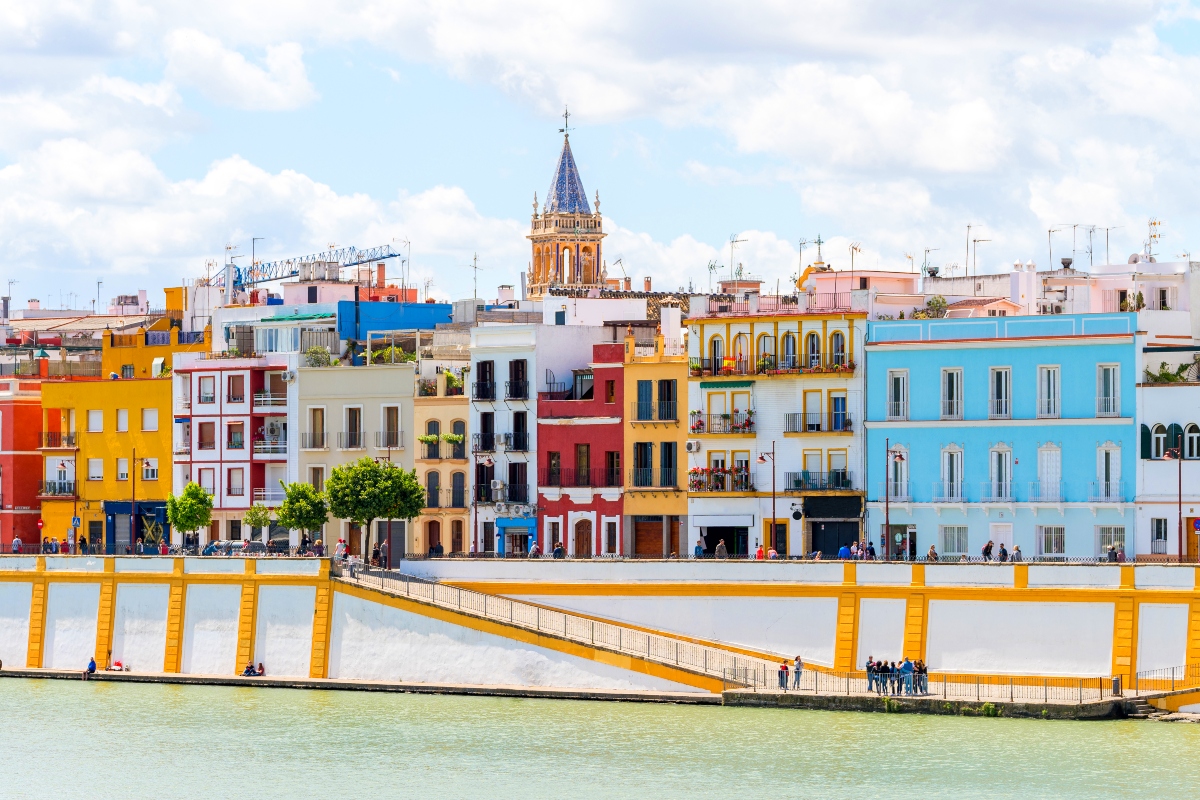
Heading down the highway towards the sea is great for getting a tan all year round. The interior, however, waits impatiently and silently for those who are still searching for pockets of authenticity.
You have to get up early to make the most of Jaén. An easy task until the GPS invites us to leave the highway and enter a demanding route surrounded, it must be said, by an imposing landscape of olive trees. They have been dressing this land for who knows how many thousands of years, witnessing the terrain of Jaén, which is both enormous and devoid of spotlights and paraphernalia.
Before settling in Baeza, we stop in the capital.
And the first stop, as logic dictates, is to climb up to the Castle of Santa Catalina. Take in the view of the churches that lie at your feet and even make out the Cathedral if you go to the top of the hill. Beyond that, the Sierra Morena, Sierra Mágina, and Guadalquivir Valley are laid bare. A spectacular sight, a preview of things to come as we slow down the pace.
Table Of Contents
Coffee at Vander
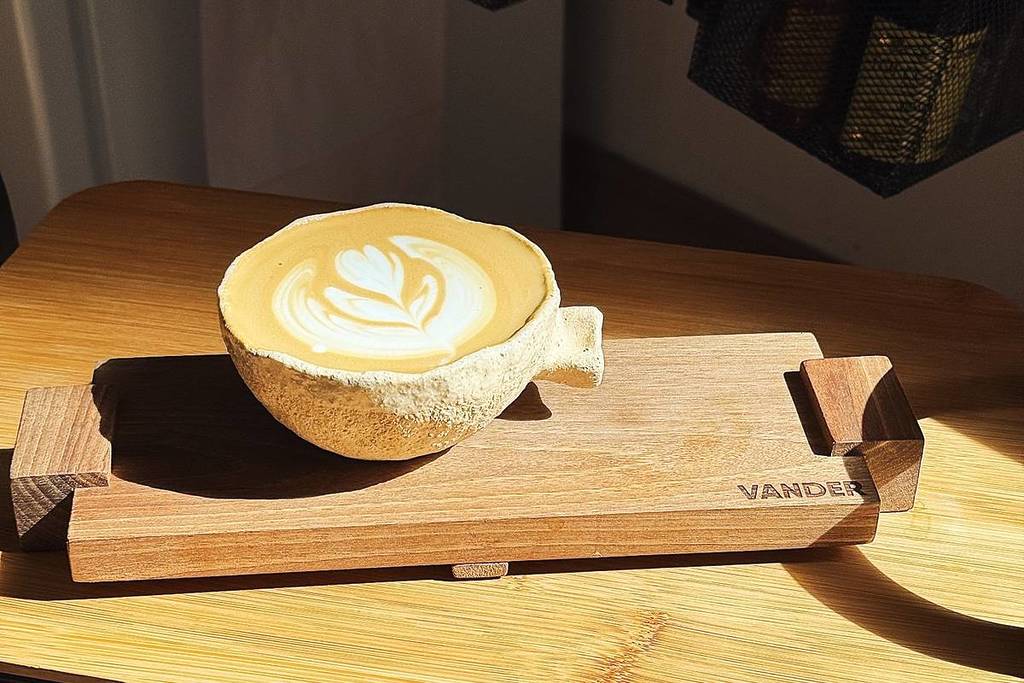
There is a coffee shop in Jaén that needs no introduction and will delight you on this urban morning. Juanma Pérez runs Vander, located at number 7 Pasaje Maza. He’ll serve you a fabulouscold brew, talk about Van der Weyden, and even stroll with you through the streets of the city. A Cicero, a coffee spirit, an artist, if you will. And Vander, a mandatory stop.
A short walk through the center is enough to appreciate the lively warmth of its people. Groups gather at bars and terraces in the midday sun.
You do the same and drop by El Hortelano for some tapas and olives before tackling the main course, the gastronomic master of this land. Less than two hours from Seville: the spectacular hotel in a 16th-century mansion, ideal for your next getaway.
Bagá, emotion without labels
Bagá may be a home kitchen, a restaurant-dining room, a laboratory, who knows. It’s not the kind of restaurant you would recommend to everyone, although there is no other restaurant like it in the world.
Weeks before visiting this temple, I heard Pedrito Sánchez on Auténtica Premium Food say that “cooking should have no limits” and that, perhaps, “to excite one person, you have to piss off a few others.”
How can we talk about the excitement that Pedro creates with his ideas, his dishes, this small salon of boundless creativity, with that flag of individuality that couldn’t care less about the precepts of haute cuisine?
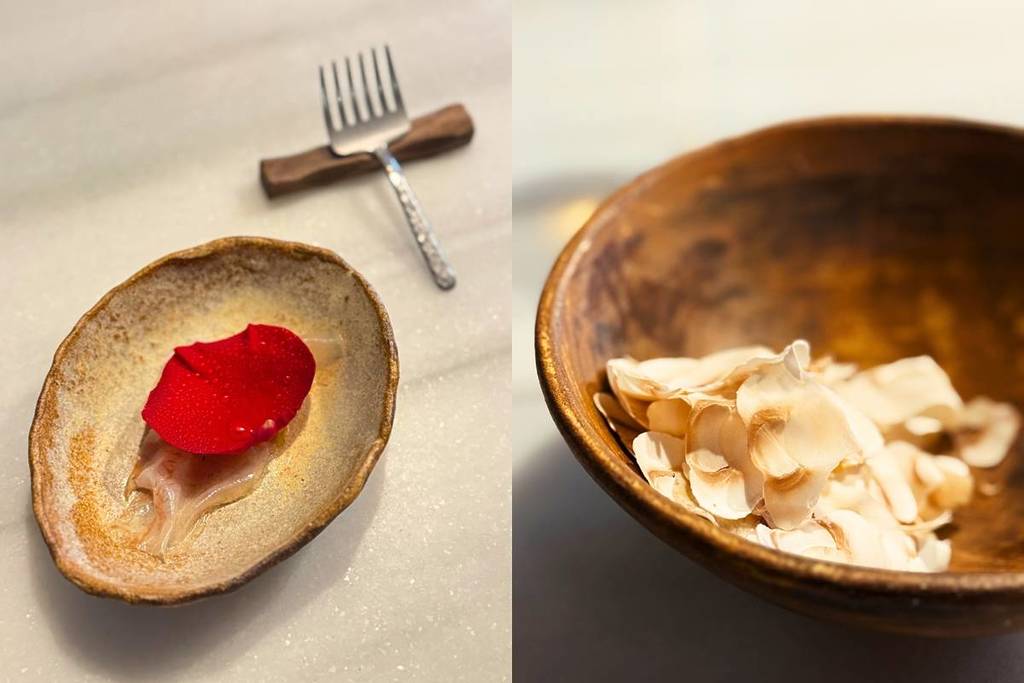
How can one talk about his caviar pine nut, a dish that modifies textures and looks at you like a circular Rothko? A panellets mazamorra, a buttery, sweet dish, a savory dessert, one of my favorites, at the zenith of the service.
Or its oxidized pear with smoked eel skin foam; the seaweed meunière or the mushroom with hake collagen that spills like a cliff, an earthy precipice.
There is a small window to the right of Bagá’s kitchen through which a delicious light filters onto dressings and sauces, plates that look like ceramic shells and cutlery that seems to have come out of the sea. A kitchen without a name, without a label.
Perhaps someone other than Pedro can wield such magic with so few gestures. I don’t think so.
From the Cathedral to the Arab baths
If the traveler has not already done so, an afternoon stroll is in order to walk off the meal and explore the untamed beauty of the Cathedral of the Assumption.
One of the great landmarks of the architect Andrés de Vandelvira, it actually served as an example for the construction of similar cathedrals in Lima, Cuzco, and Mexico City. From its imposing central nave to the Chapter House and Sacristy to the upper galleries, the cathedral in Jaén is a Renaissance masterpiece to be savored without haste.
This jewel in the crown is followed by other unmissable cultural sites such as the Villardompardo Palace, whose Arab baths nestle in the depths and are, at present, the best preserved in Europe.
Hotel Puerta de la Luna: comfort and rural luxury in the heart of Baeza
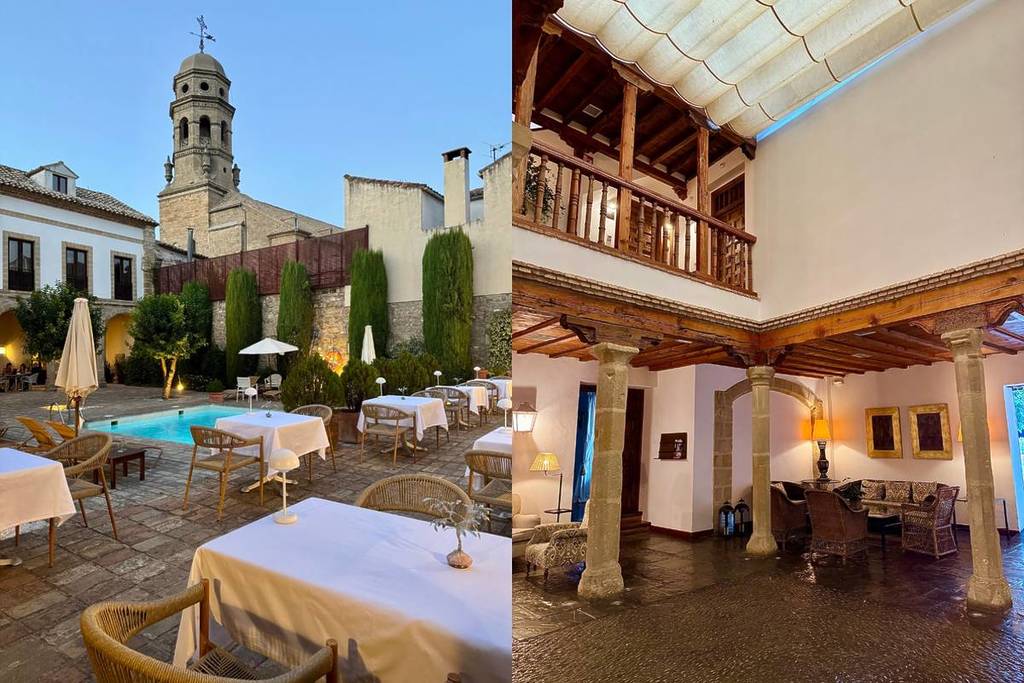
For many, Baeza embodies all the benefits of a rural getaway, and they are not wrong. The journey from Jaén is less uncomfortable, and barely 30 minutes separate these two Renaissance destinations. Seas of olive trees dot the landscape along this journey of impossible charm.
In the labyrinthine streets that make up the historic center,the imposing cathedral,Plateresque buildings, churches,anddozens of palacesrise up, some of them open to the public, others, such as the Hotel Puerta de la Luna, literally home to the public.
Hospitality, a historic location—the property occupies a 16th-century mansion with an extraordinary courtyard featuring a swimming pool and views—and suites that are an elegant journey through time make a stay here an unmissable experience.
Special accommodations, made of a different mold, that offer us a window into the luxury of admiring our heritage from our bed.
Staying within its walls is precisely that, almost a fetish. Wake up to the sight of the cathedral tower and the Renaissance courtyard, listen to the murmur of the pool, and indulge in a proverbial breakfast: olive oil, tortillas, ham, and artisan sweets.
Acebuche, where France and Jaén meet
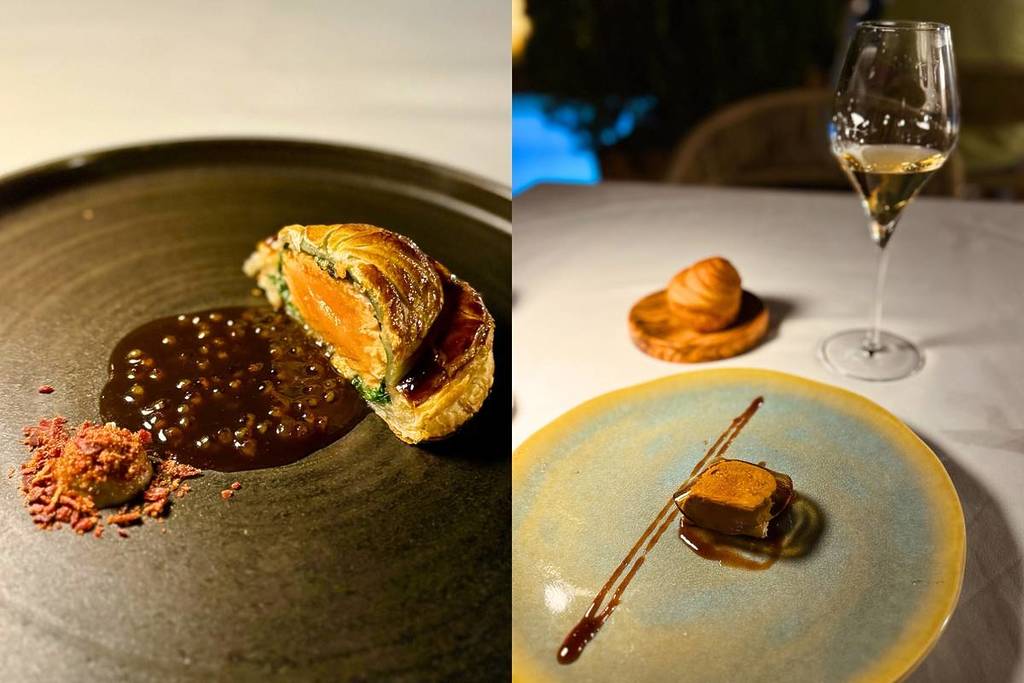 Trout Wellington – foie micuit
El Puerta de la Luna, with all its facilities, also houses a restaurant that lives up to the majesty of Baeza. During your stay, you can, and should, drop by its gastronomic restaurant.
At Acebuche, the virtues of the land are celebrated through French techniques, stocks, sauces, and preparations, combined with the gestures and products of Andalusian cuisine.
A hug between Jaén and the neighboring country, masterfully executed by Axel Guilbert and María López in the kitchen.
Their tasting menu starts with fun appetizers —from cromesqui of pig’s trotters to low-temperature cooked egg with Mornay sauce and ochío crumbs—a striking Motril shrimp with olive and cornezuelo sauce, or one of the most formidable courses of the dinner.
This is foie micuit on a base of Torres cherry jam, a veil of amontillado gelatin, and brioche bread. A dish that offers skill and recreation, the goodness of foie gras combined with the versatility and character of the Marco de Jerez.
And wine, by the way, is very important in this establishment. The pairing option offers vertical sparkling wines, wines from the region, small producers, and even local references.
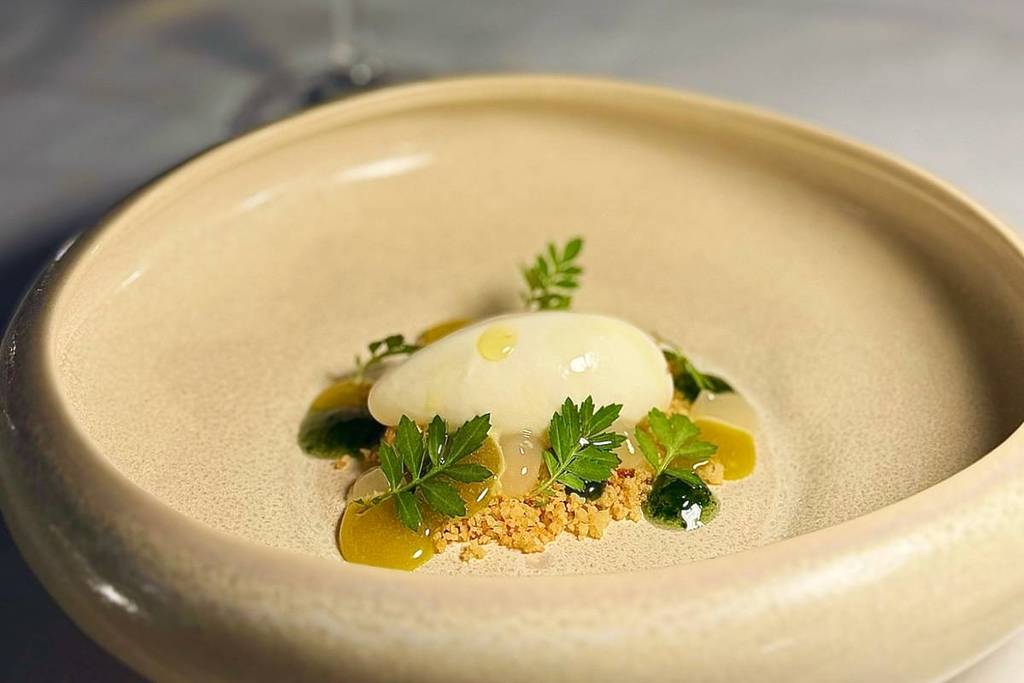 ‘Acebuche’ dessert
Other great dishes that define the restaurant’s narrative are the Cazorla trout Wellington, a meat stock with trout, spinach, and honeyed mushrooms, delicate and exuberant at the same time; or the dessert that gives the restaurant its name.
Acebuche is, as you might expect, built around olive oil. This hallmark dish contains EVOO jam, Breton sablé, blanc quenelle, textured milk with gelatin, and drops of lemon, thyme, and mint-flavored EVOO.
The menu includes other successful recipes such as pâté en croute andSegureño lamb.
A well-stocked wine cellar, a coherent and appealing menu, and some outstanding dishes that you will remember for a long time.
Vandelvira: a 16th-century convent that exudes gastronomic talent
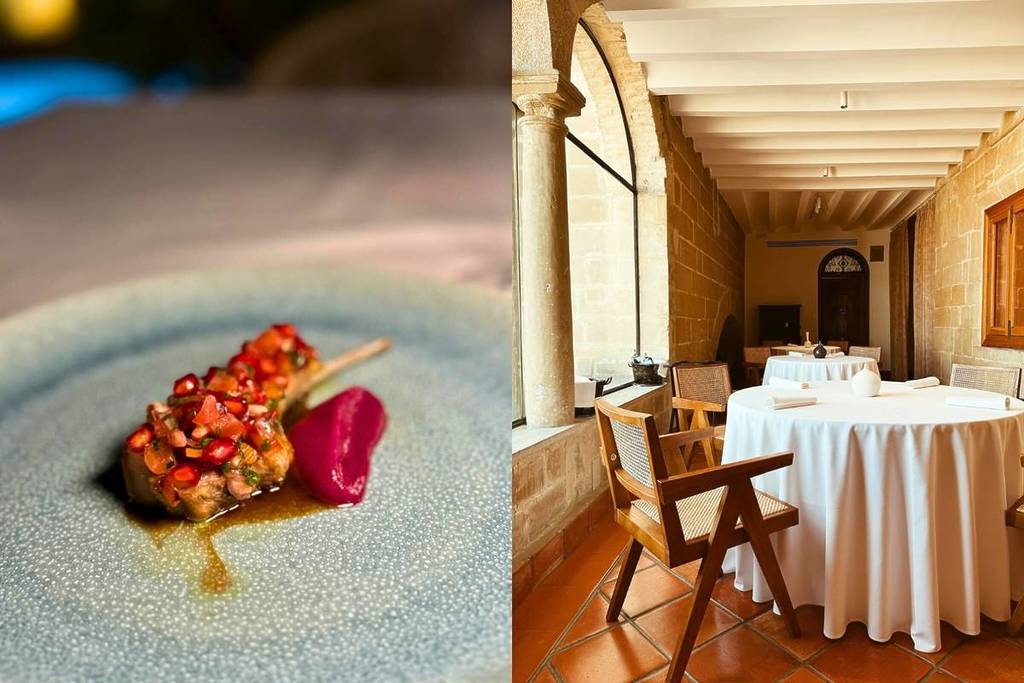
And if we want to escape from this captivating bubble, there is no place like Vandelvira to savor architecture and cuisine at the hands of the approachable and visionary genius that is Juan Carlos.
You have to be very unique to work without clumsiness, to live up to this spectacular Renaissance convent. However, they execute a brilliant tasting menu, free of constraints, with sensitivity and panache.
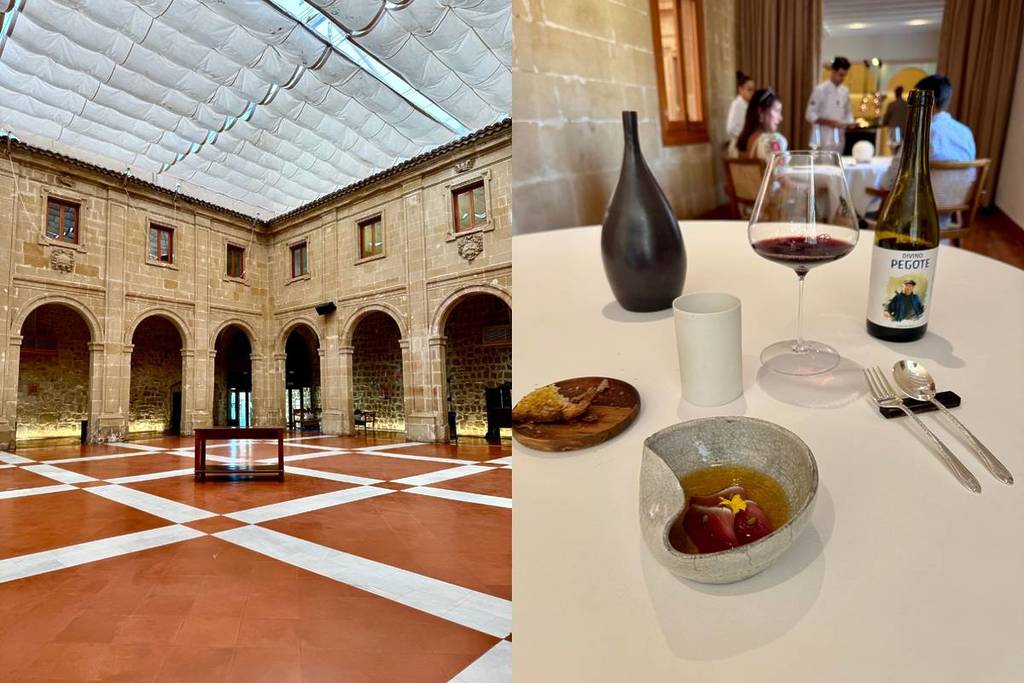
A promising restaurant that will continue to provoke rivers of ink in guides and media and that does justice to the memory of the architect and this town overflowing with beauty.
At the dawn of the feast, there is a squid that wanted to be ham, a chard beurre blanc and palodu, or the unexpected veil of candied potato with kombu seaweed and vanilla.
There are also dishes that you would want to dive into without shame and which, on the other hand, are traps for the eye. The kokotxas, the pipirrana, the profuse flavors of the rabbit, and its peculiar foie gras are top-notch.
The dessert course is clearly refined, following Juan Carlos’s style.
Vandelvira showcases a cuisine with personality, dynamic and avant-garde, as the team maintains.
A Machadian postcard
The Bagá menu recites the popular saying that I was skeptical of from the beginning: “You enter Jaén crying and you leave crying.” However, I see myself on an autumn Sunday leaning on the trunk of the car, observing a Machadian postcard and feeling the first hints of melancholy blossom.
From the Mirador del Obispo, not wanting to return to Seville and figuring out how to come back soon, I recall the words of the master:
From the Moorish city
behind the old walls,
I contemplate the silent afternoon,
alone with my shadow and my sorrow.