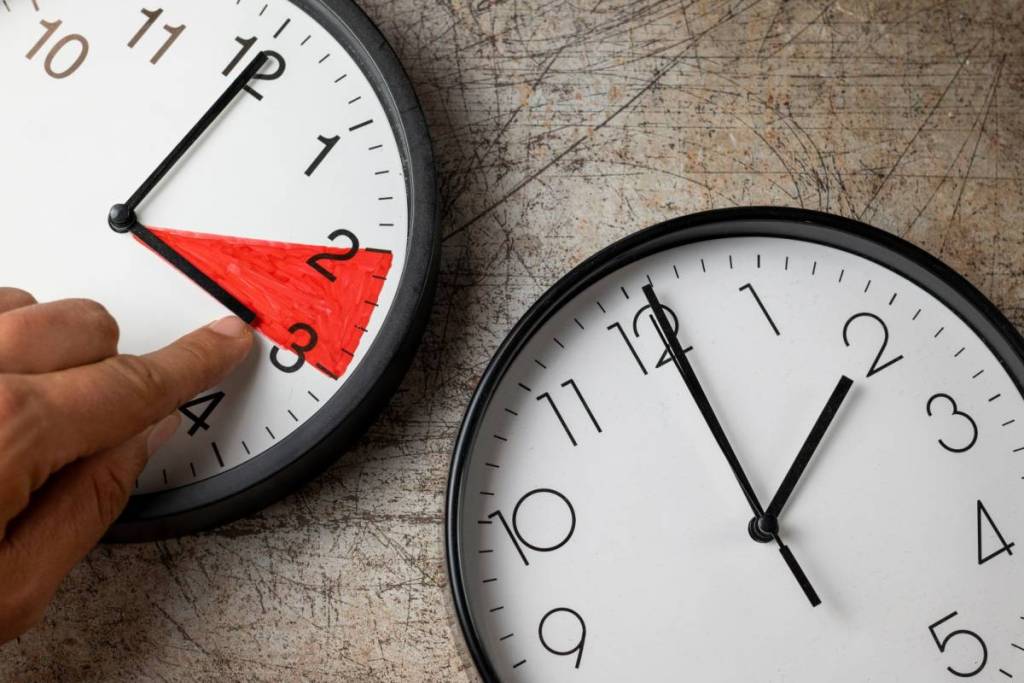

The time change taking place this Sunday has been happening in Spain for 86 years now. At 3:00 a.m., the clock will go back to 2:00 a.m., giving us an extra hour of sleep and officially marking the start of standard time. This everyday ritual traces its origins to 1940 and a historical peculiarity: why does Spain share the same time zone as Berlin despite being right next to the Greenwich Meridian?
To understand why we in the south stay up late on Central European Time, we have to go back to 1940, at the height of Francisco Franco’s dictatorship, when it was decided to set Spanish clocks forward 60 minutes.
Why do we have the same time as Germany?
Until March 16, 1940, the Iberian Peninsula was governed by the Greenwich Meridian—the same one that today dictates the daily routine of our neighbors in Portugal and the United Kingdom.
However, an order published in the Official State Gazette (BOE) changed the rules of the game. The official justification was to harmonize our time with that of the rest of Europe. And although for decades it has been said that this was a direct nod from Franco to Nazi Germany, historians and experts such as astronomer Pere Planesas point out that there is no conclusive documentary evidence to confirm that theory.
In any case, that “provisional” measure ended up sticking, and since then, Andalusia, the Balearic Islands, and the rest of the Peninsula have shared a time zone with Berlin (UTC+1 in winter and UTC+2 in summer), while the Canary Islands continue to maintain their usual time, which is one hour behind.