
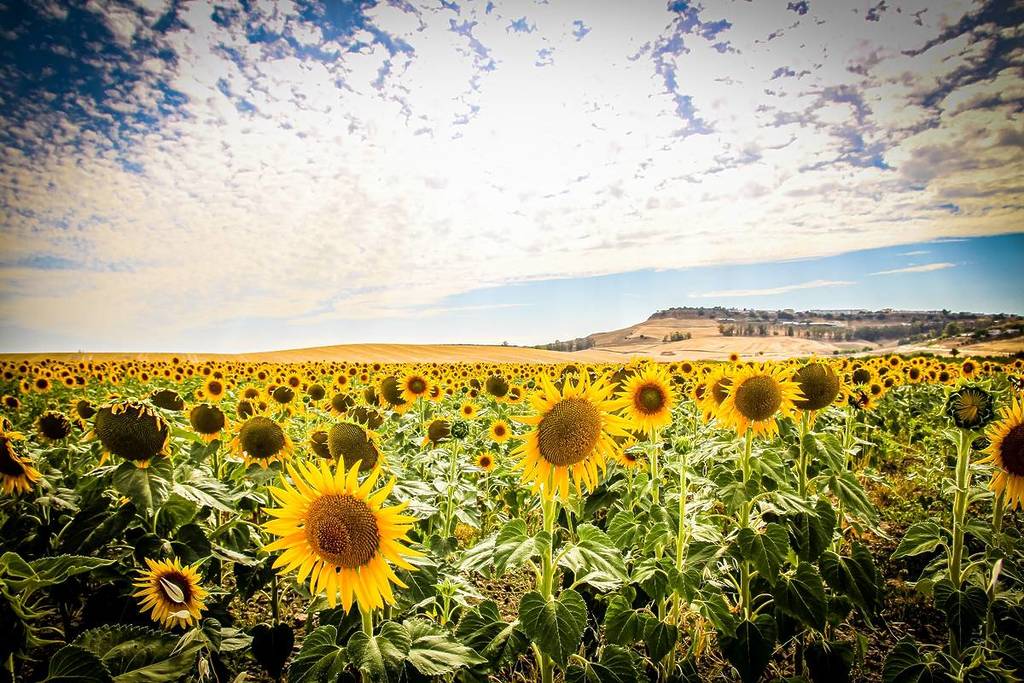

In recent years, the town of Carmona has experienced an unprecedented phenomenon—and it’s not because of one of its historic monuments. Carmona’s sunflower fields, far from being merely a rural landscape, attract thousands of tourists. Between May and June, the area surrounding this Sevillian town is painted yellow with fields full of sunflowers. Some people even go so far as to hire a taxi to drive through this sea of flowers and take a selfie.
This trend—which leads many people to discover various fields in bloom, from the almond and cherry trees that beautify spring to the lavender fields that are about to bloom—is not new.
Its popularity has already reached the international press, and National Geographic magazine has dedicated an article to the best destinations for seeing flowers in bloom, with Carmona earning a spot among the chosen few. Specifically, it ranks second among European destinations, behind the tulips of the Netherlands.

Seville’s yellow sea that has captivated National Geographic
The prestigious publication describes Carmona’s extraordinary landscape in these words:
“Carmona is one of the many white villages, painted with lime wash, that crown the hills of Andalusia. During the spring, sunflowers bloom across more than 74,000 hectares around the town. The best time to see them is from May to June, and you don’t need a car to get there.”
This natural spectacle has become the ideal setting for professional photographers and content creators from around the world. The golden light of the Andalusian sunset, combined with the contrast between the endless yellow of the flowers and the whitewashed village in the background, offers one of the most Instagrammable scenes on the peninsula, transforming rural tourism in the area into a fully sensory experience.
The origin of Japan’s obsession with this corner of Andalusia
Although COVID-19 has prevented the usual influx of Asian tourists, Japanese tourists are among those who are most drawn to this getaway near Seville. In fact, more than 3,000 people from Japan come to see them every year.
Apparently, 15 years ago, Japanese television aired a very popular animated series about King Don Pedro.Over time, however, interest shifted to the town’s sunflower fields. For the Japanese, they are a symbol of life, light, and energy.

Beyond beauty: the “superpower” of sunflowers
Given this precedent, the Carmona City Council, through the Tourism Office, has encouraged visits to this area by offering amenities to visitors, who are increasingly local.
It is said that sunflowers help clean up nuclear radiation. That is why they are often planted near nuclear power plants.
In fact, after the nuclear accident in Fukushima, sunflowers were grown in the area because it has been proven that they absorb radiation.
This is due to a biological process known as phytoremediation: sunflower roots are capable of absorbing heavy metals and radioactive elements (such as cesium and strontium) from the soil and water much more efficiently than other plants, acting as true ecological “vacuum cleaners” for the planet.
Yet another reason to admire this miracle of nature that blooms every spring in Carmona.
