

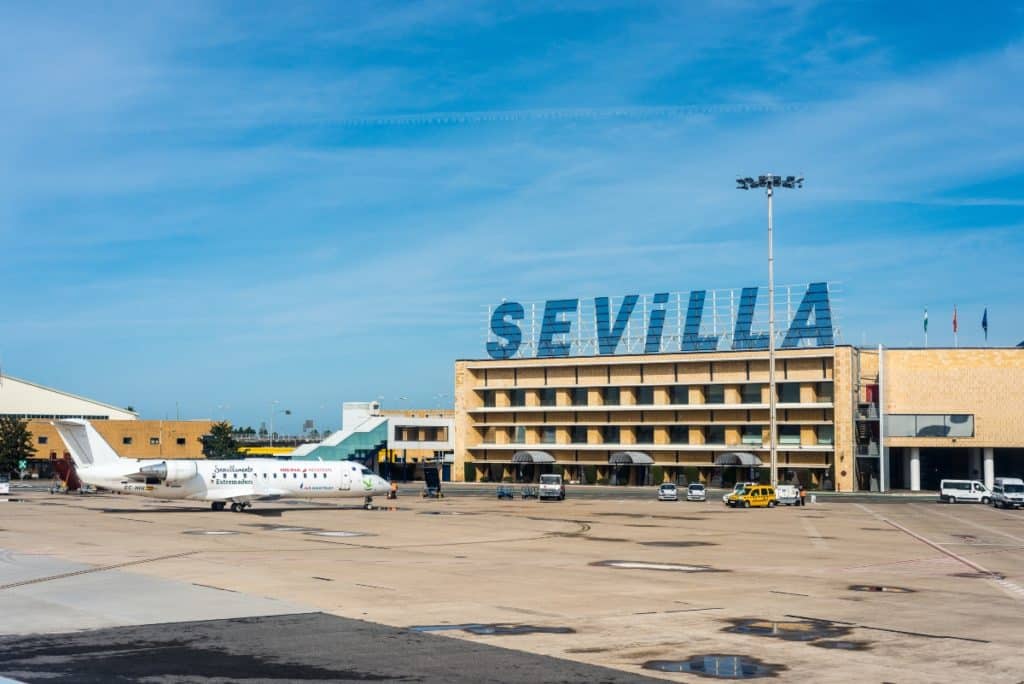
Unless you’ve stopped to check the codes for the various destinations at the airport, you may not have wondered why some of them are so strange or confusing. The IATA (International Air Transport Association) code for Madrid Airport is MAD, Barcelona’s is BCN, but why is Sevilla SVQ?
Surely, you’ve ever racked your brains wondering where that mysterious “Q” comes from, and you’re finally going to find out. Each airport has an IATA code composed of three letters.
Recommended Articles
 The Navigalia Christmas light show returns to Seville with a nativity scene featuring lights and sound on the river and 56 performances: this year, tickets cost 3 euros per person
 Seville moves up Christmas 2026 to November 27: 300 streets and 35 monumental 9-meter-tall “giraldillos” on Avenida de la Constitución will be lit up before the long weekend
The usual practice is to assign the first three letters of the name of the city to the code in question (Madrid, MAD), although it is not strictly necessary, as is the case in Barcelona (BCN) or Cordoba (ODB).
Other codes as puzzling as Seville’s SVQ

When the initials cannot be fixed with the previous method it is decided to use the name of the city toponymically, or to name the island and not the city. There are occasions when the airport code may match, but this only happens in 1.5% of cases.
In the case of Seville, its IATA code is not SEV but SVQ, because this belongs to a Ukrainian city, Severodoneck. Regarding the mystery of the Q, it was simply put arbitrarily, as happens in cities such as Santiago de Compostela (SCQ), La Coruña (LCQ), Granada (GRX) or Málaga (AGP).
.
