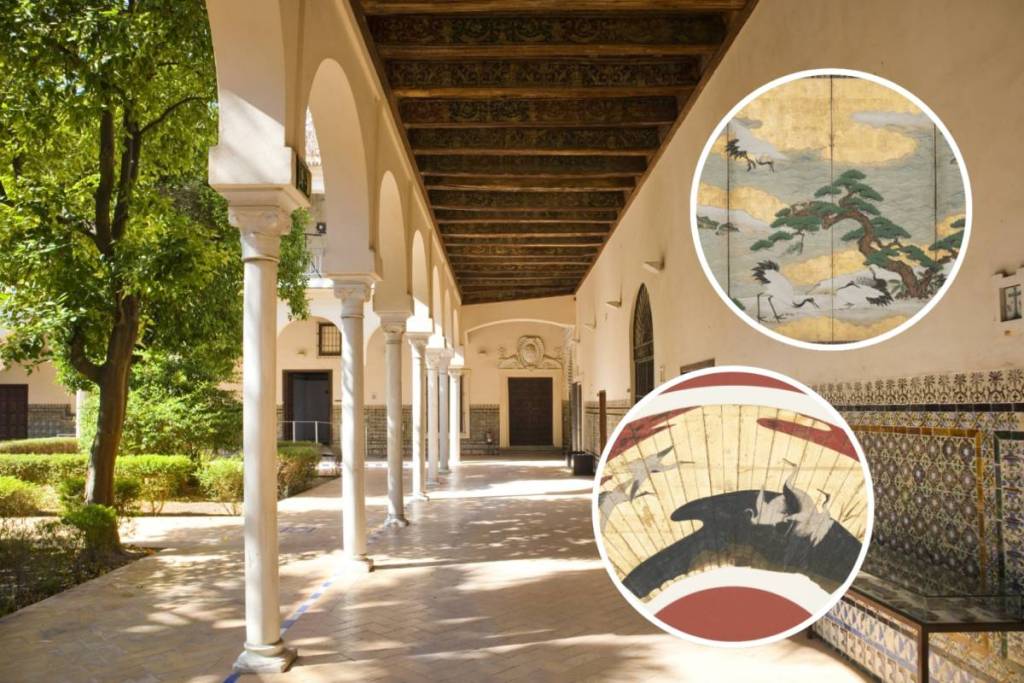

The former Convent of Santa Clara houses a space of the same name dedicated to exhibitions, concerts, performing arts, and literary events. A sort of cultural hub in a beautiful building where visitors can be enchanted by everything from the cloister to the interior gardens. On October 20, the Espacio Santa Clara will open “KINPAKU: Nature, Power, and Imagination in Japanese Art,” an exhibition in which light takes center stage as an unexpected protagonist.
Kinpaku, Japanese gold leaf, covers the backgrounds of ten folding screens and sixteen fans dating from the 16th to the 19th centuries. Each piece changes depending on how the light falls on it. The exhibition will remain open until January 10, 2027.
The official opening is this afternoon at 7:30 p.m., featuring the curators, Professor Hiroyuki Kano and Dr. Daniel Sastre de la Vega, along with a representative from the Japanese Embassy. The event will conclude at 8:15 p.m. with a reception featuring sushi and sake.
Folding Screens That Transformed the Space
At the heart of the exhibition are the byōbu, whose name literally means “to block the wind.” Their function went far beyond the practical: they delineated rooms, lent them a sense of solemnity, and defined the relationship between people and the space. They appeared at births, weddings, banquets, and funeral rituals, and were exchanged as diplomatic gifts among the Japanese elite.
Pine trees, cranes, bamboo groves, peonies, insect cages, autumn grasses, and snowy landscapes unfold against the gold. There is also literature: scenes from *The Tale of Genji* and palaces that seem to float above the clouds. Alongside the large compositions, designed to transform a room, there are small folding screens for more intimate spaces.
The sixteen smaller fans served as gifts, calligraphy supports, and objects of courtly social interaction. They depict a phoenix on a paulownia tree, the legend of Tōbōsaku with the peaches of immortality, and a scene from *The Song of Everlasting Sorrow*.
The exhibition focuses primarily on the Momoyama (1573–1615) and Edo (1615–1868) periods, when large gilded folding screens became established as symbols of authority in the halls of power.
The Kanō school and the figure of Kanō Eitoku help shed light on this development. “No photograph can convey how light makes the gold leaf shimmer, like a silent dance,” notes curator Daniel Sastre.
Tours and Lectures
Mayor José Luis Sanz welcomed the exhibition and emphasized that Seville has always been “a historic bridge and a land open to encounter.”
Here are the dates for the public:
- On Wednesday, October 21, at 11:00 a.m., there will be a guided tour of the exhibition led by Professor Hiroyuki Kano.
- Also, on Tuesday, October 27, at 5:00 p.m.: a lecture on kintsugi and the use of gold in Japanese art, featuring Japan’s ambassador to Spain, Hiroshi Yamauchi.
Between October and December, there will also be a series of free and open lectures on Wednesdays at 5:00 p.m., except for the one on October 21, which will be at 11:00 a.m. with Professor Kano.
The announced dates are October 29, November 11 and 25, and December 23. The speakers for these sessions are to be confirmed. The program also includes a date listed as November 9, which is not a Wednesday, so it’s best to confirm this date before attending.