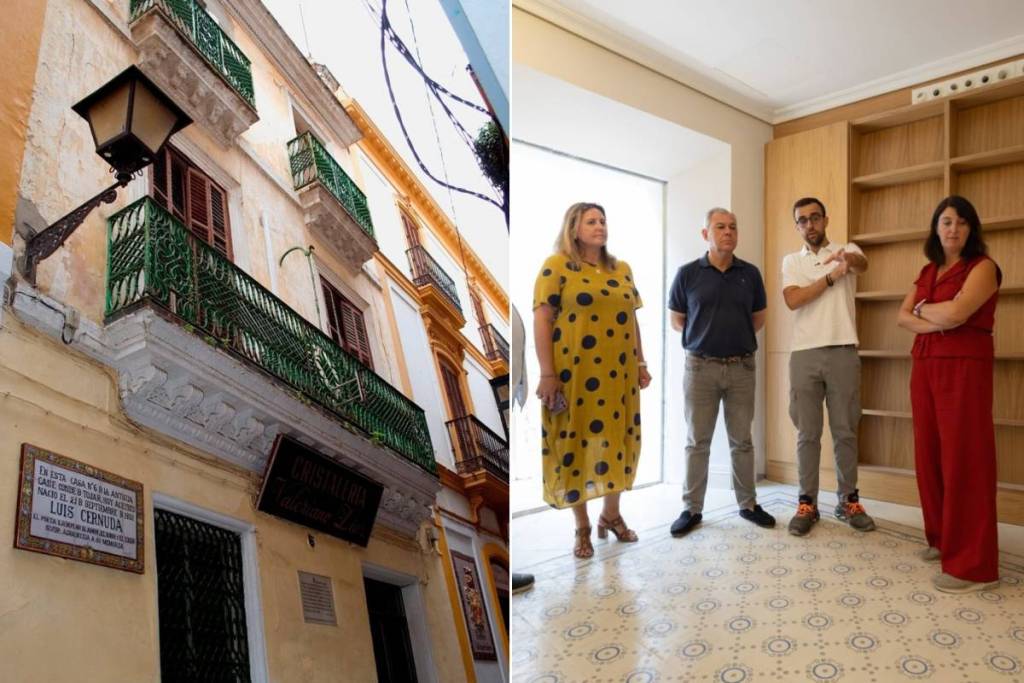

He lived in this house can be read on dozens of commemorative plaques throughout Seville. Just drop by Dueñas to come face-to-face with Machado’s lemon tree, or take a stroll down Alfalfa Street and admire the modest house where Velázquez was born. And near El Salvador stands the house of Luis Cernuda, now restored, which will open in mid-December as the Casa de las Letras de Sevilla.
Seville is expanding its museum offerings with this cultural center dedicated to the poet and the entire Generation of ’27.
For Cernuda, the house was a place of longing, marked by an irremediable sense of alienation and a reminder of exile. Now, this home on Acetres Street is being transformed into a space of remembrance where visitors can trace the poets of ’27 and engage with their literary legacy.
The opening is scheduled for December 16, 2026.
The Department of Urban Planning and the Environment has directed and carried out a renovation project that began in September 2024 and cost 1.5 million euros.
The mayor of Seville, José Luis Sanz, announced it with these words:
“After 10 years of waiting for its restoration (…) we have reclaimed the Casa Cernuda. In doing so, we are not only restoring a historic building but also returning to Seville the memory of one of its most universal poets. This space will become the nerve center for commemorating the Generation of ’27 and a cultural landmark where new generations can discover and enjoy Sevillian literature.”
Cernuda was born in Seville, in this house in the city center, in 1902, and left it for good twelve years later—112 years ago.
The process included the City Council’s purchase of the house, its clearance, archaeological surveys, construction plans, and the museographic and museological plans.
A structure that has been preserved
The renovation work has reinforced the structure and renewed the roofs, utilities, and exterior cladding. The initial plan called for replacing nearly all the wooden beams in the upper floors. A new study conducted during construction showed that most were strong enough, so only the worst ones—those in the gallery area—were replaced.
To comply with fire safety regulations without altering the original wood, the team has installed a continuous drop ceiling. They have also applied a preventive treatment against termites to the ends of the beams.
The roof once again features ceramic tiles after the fiber-cement panels from previous repairs were removed. In addition, there is a new reinforced concrete staircase and silicate paint on the interior. The traditional “jabelga” style has been preserved for the façade facing Acetres Street.
The excavation work also brought to light archaeological remains from the 19th-century house, such as the floor of an earlier dwelling, vaults, and the foundation of a fountain. These discoveries extended the project’s timeline. They remain protected beneath the ground and have been documented.
The mural paintings, the great discovery
When the modern wallpaper was removed, the original decorative paintings of the house, built in 1900, were revealed. They were executed in tempera and were severely deteriorated. A team of restorers consolidated them, cleaned them, stabilized the paint layer, and replaced the missing mortar with lime and sand, always adhering to the principle of minimal intervention. They then restored the color of the damaged areas using tempera and watercolor and protected the entire surface with Paraloid B-72 resin.
Visitors will be able to view them throughout the ground-floor gallery and in part of the upper floor. Their discovery necessitated relocating the elevator shaft to preserve the walls that house them.
With the renovations complete, the ICAS—part of the City Council’s Culture Department—will now adapt the space for use as a museum. Anyone who steps through the entrance will be reminded of the courtyard Cernuda described in *Ocnos*: the lowered awning, the cool twilight, and the six-pointed star of red cloth on the canvas.